Friday, August 31, 2018

2018 Scotland - Cattle, Battle, Dogs and Fiddles

We had a nice chat with William this morning and asked whether he raised his Cheviot sheep for wool or meat. They are destined for the table. He explained that the fleece of Scottish sheep is not really profitable, about 50P per fleece. It's coarse and not practical for jumpers (sweaters) and such. It's usually shipped to China and India for use in rugs and carpets. He does shear his sheep, though, "because it's the kind thing to do, isn't it?" (The wool of unshorn sheep will keep growing and matt into heavy dreadlocks.)

William told us that Scottish sheep farmers are concerned about the effects of Brexit upon their livelihood. The French, for example, love Scottish lamb. But without the EU protections , there will be more competition from New Zealand and Australia.


We were relieved we did not have a fire in the bunkhouse last night, because we did not see the handy escape procedure until this morning!


We completely revised our initial plans for today and decided to drive up the western side of Loch Ness and through Inverness to see the Culloden  Battlefield. This was on Lydia's original Scotland must-see list, but it didn't seem to fit in at first. 

On the way, we were excited to spot a small flock of Scottish Highland cattle on the side of the road. Characterized by long horns, long wavy coat and  inscrutable eyes behind a curtain of bangs, they are the cutest cows imaginable. Their long coats help protect them in the winter. They are raised principally for meat.


We drove the length of Loch Ness with several glimpses of the water from the road, but none of Nessie. We didn't stop for a good search, though, as we were focused on our next destination.

On April 16, 1746, Culloden was the site of the last battle on British soil, and the death knell for the Jacobite uprising led by Bonnie Prince Charlie. The battle lasted only 40 minutes. The Jacobites were both outmanned and outclassed by the superior forces and weaponry of the George II supporters. Like Civil War sites in the US, Culloden Moor is preserved with a few memorial sites and quiet places to reflect. There is also a modern interactive visitor's center that walks you through the history leading up to the battle.


Memorial cairn at Culloden 

Markers commemorate the graves of the clans.


This old croft house was used as a hospital after the battle.

We had rearranged our itinerary both to see Culloden and to visit a working sheepdog demonstration that we'd heard about from a couple we'd meet on Skye. The demonstration was at 4 pm. Our host last night, William, was very keen to learn more about this when we mentioned it to him this morning and asked us to let him know how it is. He uses three dogs on his farm.

The Leault Farm in Kincraig is typically bucolic Scottish countryside: hilly, rocky, sparsely dotted with sheep and a rare farm structure. The trainer's two sons, around 8 and 12, directed us to park and collected £5 each. Dogs and some unperturbed lambs (we later learned they are orphaned lambs that are being handfed) wandered around the area until Neil Ross pulled up in his truck. As soon as they heard the truck, the dogs leapt to attention and quickly surrounded their trainer when he got out of the truck.


Resting up until the boss arrives.

The demonstration was great. Neil introduced the 11 border collies he was working with today (he has about 2 dozen trained), which included a 20 week puppy that participated with great enthusiasm although not yet trained. 

The sheep spend the winters about 30 miles away, free ranging in the highlands. They are rounded up in the spring, separated according to owner and turned out to graze on the farms. They are sheared in June and July, a process that takes a farm several weeks. As William had told us, the pelts are shipped to Asia. It takes 4 or 5 years for the sheep to reach market size, so the sheep are herded back into the hills in the fall, then cycle through again. Neil said that the meat of a sheep is worth £50 while the wool perhaps £3.

Nell used a system of shrill whistles to signal and direct his dogs through their paces. Each knows its own signal, plus the cues directing what they should do. They were eager, attentive and responsive. Those not being directed would lay down or trot among the spectators until they heard their signal.

Three dogs were sent over the hills and returned shortly with a group of sheep, darting back and forth to pick up stragglers.


The shepherd's crook is used to pull a sheep out of the scrum, hooking over its horn.


The sheep became totally passive when turned on its back.


Lydia took a turn at shearing the sheep.

And on to Ballinluig, a small village near Pitlochry.

We arrived at our Airbnb to find the house empty. I called, and Wayne was there in 10 minutes to welcome us with tea and some some gourmet cookies from the chocolatier where his wife works. He invited us to join him and his son, Liam, at a weekly session of traditional music at a "wee historic town" 8 miles away. I said yes, Lydia decided to pass. So I am writing this part of the blog in the bar of the Royal Dunkeld Hotel, enjoying a half point of hard cider. Sixteen local musicians (fiddlers, recorders, accordions, bagpipe, flute, guitars) are jamming with great precision. Wayne is playing accordion; Liam, (who teaches high school music), is playing fiddle and a guitar his grandfather made of rosewood. It's grand!


I'll try to add a link to a video later.


Thursday, August 30, 2018

2018 Scotland - Skye: we take our highest road

We've been enjoying the two other young American couples sharing the B&B with us, comparing notes on experiences here and getting new ideas. We are all leaving today.

Today started out clear and breezy, perfect for walking.  Our hosts, Don and Gale (he is a photographer; she an artist) kindly lent us yet another hiking guide and provided Lydia with some waterproof boots to wear today.


Gail and Don, with some of their artwork which is displayed throughout their home.

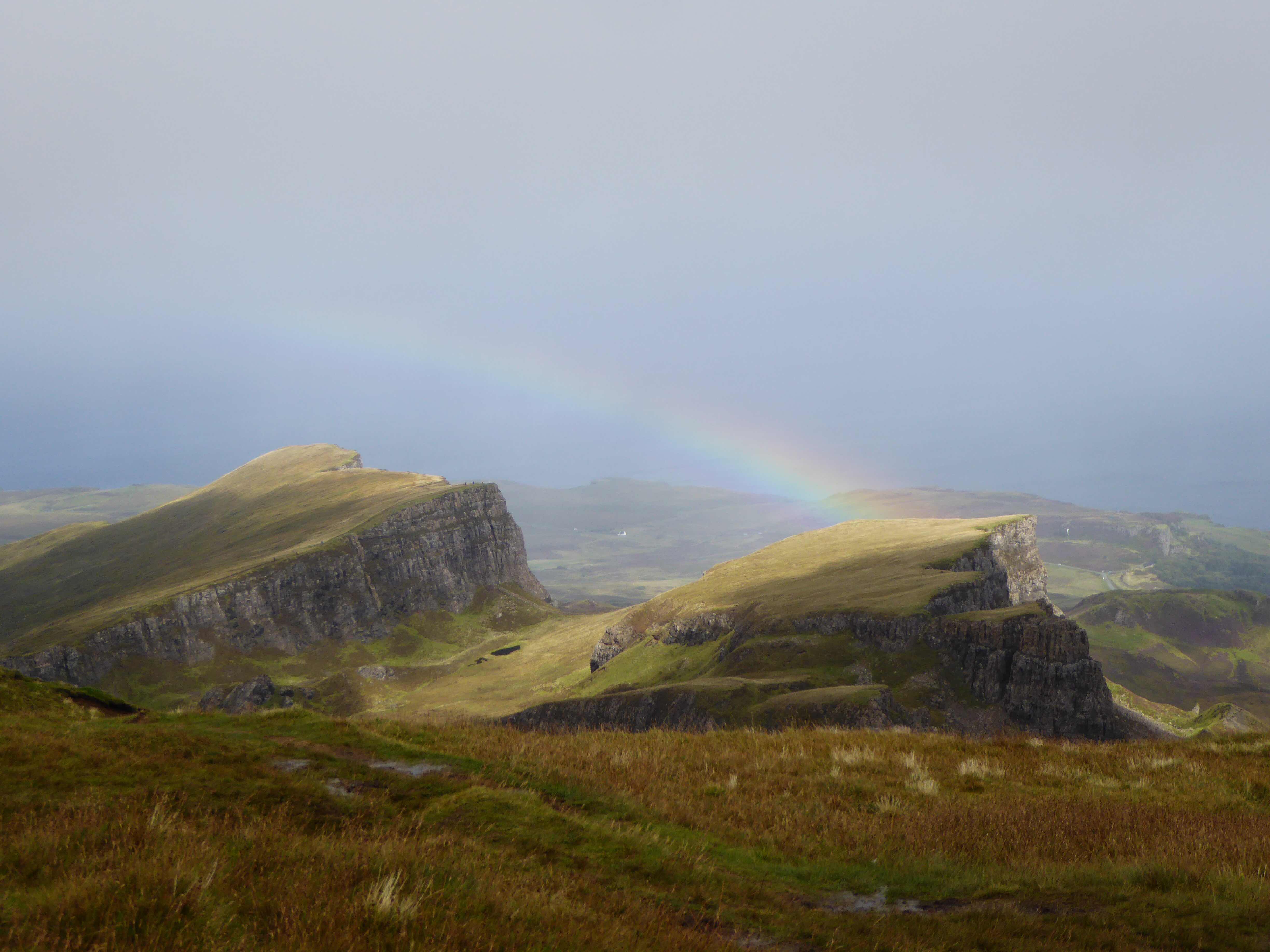
Our destination was the Quiraing, a 6 mile walk in the northern part of the Trotternish peninsula with a 1400 foot climb and spectacular views throughout. We made a quick stop at the bakery for another stuffed roll for lunch and were off.

Everything looked so much better today that we made a couple of photo stops on the drive up.


Old Man of Storr. We'd hoped to hike here yesterday, but weather precluded that.


View looking south

The trailhead was up a steep one-lane road with the usual turnouts to allow cars to pass each other. After a few final tight switchbacks, and a lot of jockeying to fit our little car onto a create-a-space on the side of the road, we were ready to go.


And now there will be a lot of pictures. And since they are each worth a thousand words, I won't write too much. 


The main trail led straight ahead, but on Don and Gail's recommendation, we looked for a less-used trail that split off to the left and gradually climbed up (but not the cliffs in the photo above). 


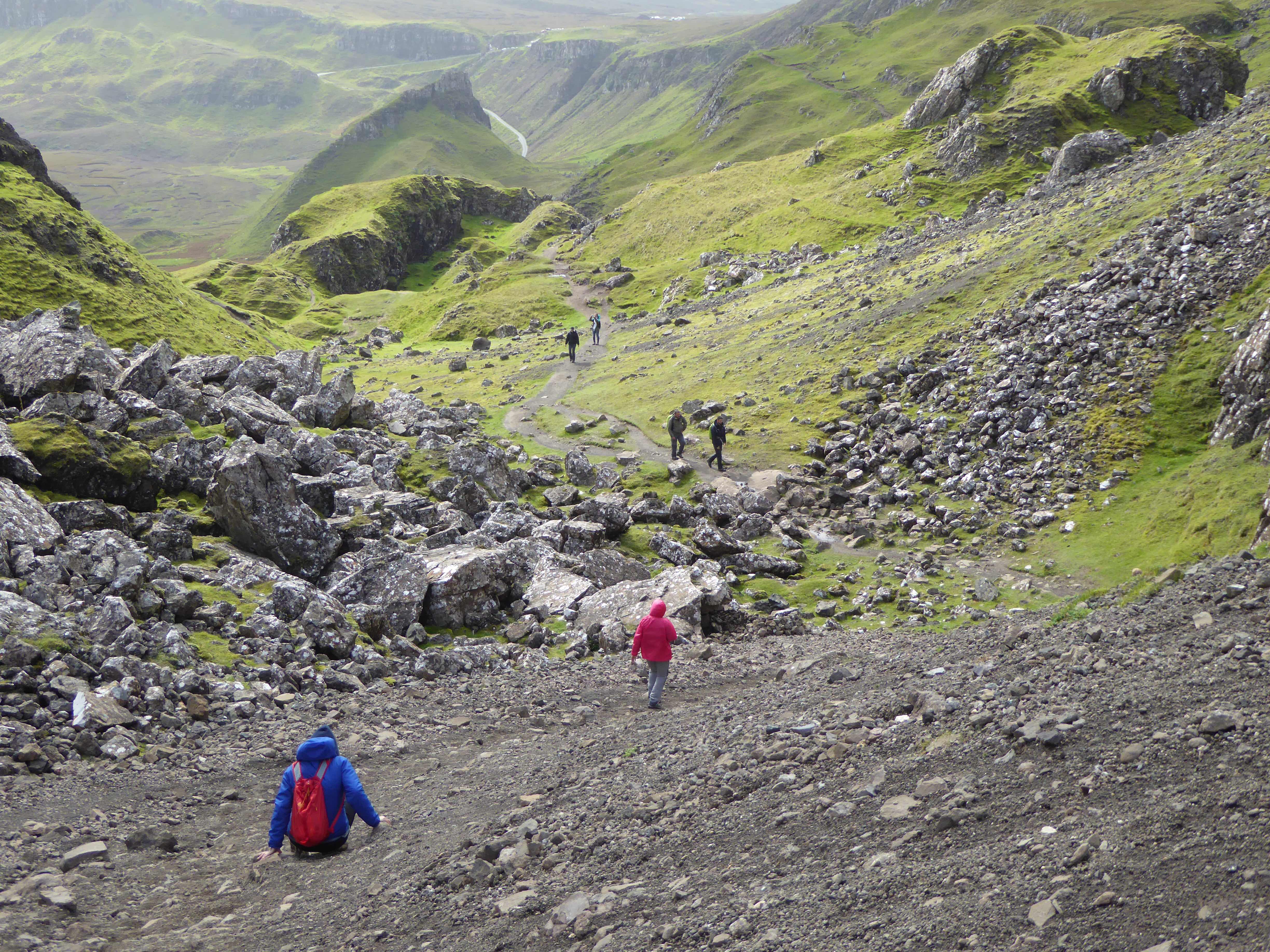
It got progressively steeper. I had trekking poles, but both of us were scrambling with hands and feet by the time we made the top. The views got better and better until the first storm swept through.


At the halfway point after our second storm (bonus round: this time we had driving sleet and winds that could knock you off balance as you stepped), we climbed over a stile and started down a steep rut of a path. It quickly dropped out of site in a shoulder-deep gully and we were concerned about how difficult it would be to get down, but after two quick turns, it got considerably easier. 


The guy in the center of the screen behind Lydia shows the scope of the scenery.


Blankets of hillside heather


A rare (unverified) photo of me


Another stile 


We can see the road in the distance. Only 1.5 miles to go.

And a couple more waterfalls to ford.


Looking back.


We made it, ready for a wash up and a very late lunch. 

After stopping at the B&B to drop off the boots and trail book, we were on our way to a bunkhouse on a farm near Kyle of Lockalsh. 


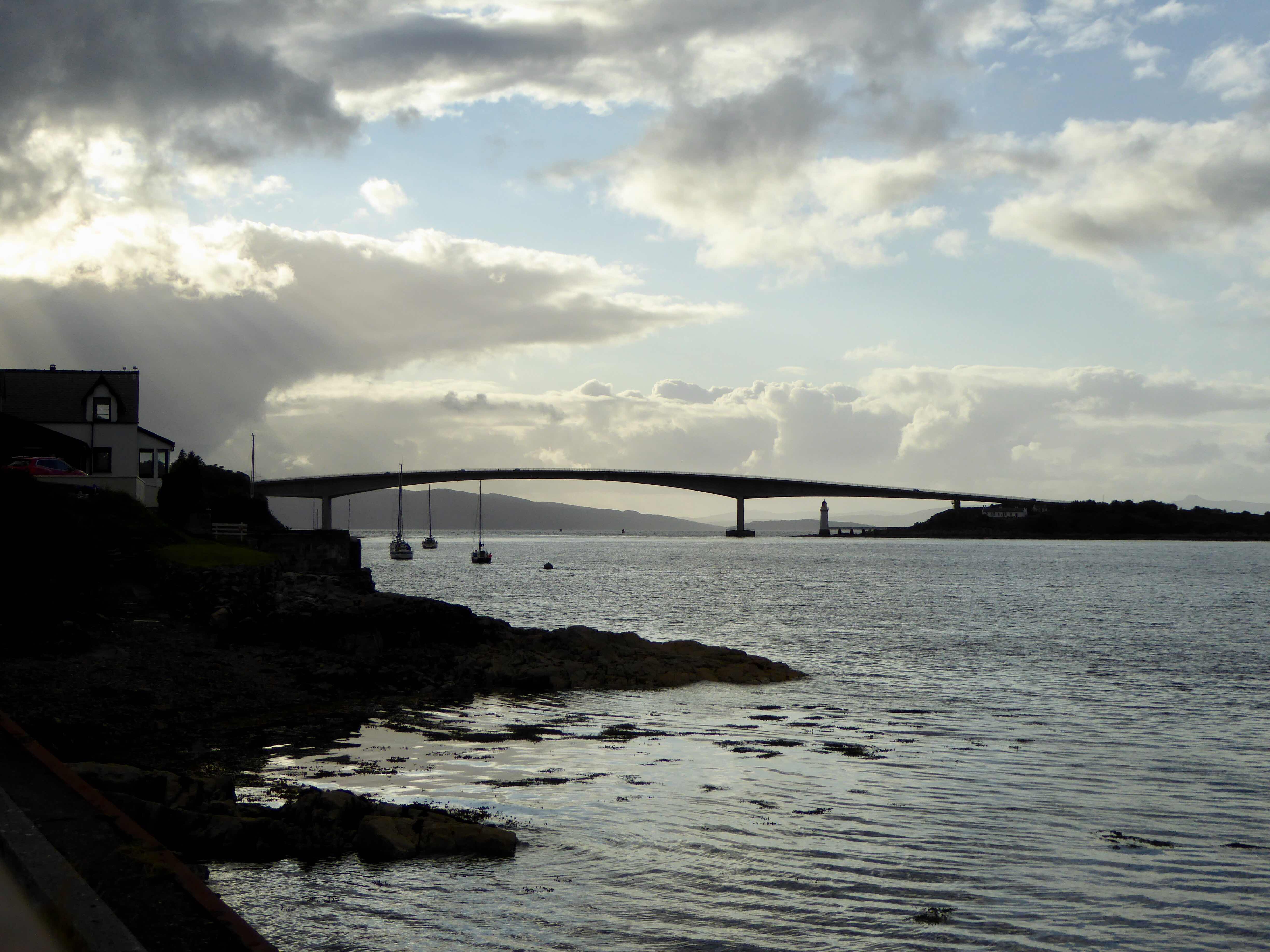
Bridge connecting the Isle of Skye to the mainland

Although it was a mile or two past our turnoff to the farm, we drove on to Eileen Donan castle in Dornie. The castle was closed for the day, but we were able to cross the bridge and walk around the outside (which, we discovered, you can't do without a ticket if the castle is open).

The island on Loch Duich upon which it sits has been inhabited since at least 618, when Saint Donan lived there. The Mackenzies built a castle there in 1214. It was destroyed during the Jacobite uprising and lay in ruins for several centuries. In the early 20th century, the MacRaes rebuilt the castle according to the original plans. Learning it was a reconstruction, we decided to skip the tour tomorrow and just enjoy our free look today.


Looking east from the castle base


And west.

We are staying tonight on a farm tucked up in the hills about 8 miles off the main road, near Kyle of Lockalsh and the above-mentioned castle. It's a funky little bunkhouse building which we're sharing with a young Australian couple. According to the current owner, William, the building originally housed a family. It was then gutted and used as a cow pen. Now it's been converted into a very rustic and cozy two bedroom Airbnb unit. William no longer has cattle; he raises sheep. We were sorry to learn he has no highland cattle, but perhaps we'll come across some in the next couple of days.


It's quiet here. No Wi-Fi. No phone. No television. Quite nice. I haven't been able to post the blog for the last 3 days, but at least the writing is done.


2018 Scotland - The Skye is Falling (in buckets)

The morning was drizzly and windy, ideal for getting the tyre repaired. (It was also the nicest weather of the day, but we didn't know that yet.) Fortunately, as our rental car has no spare, it still wasn't flat so we were able to carefully drive the few miles into Portree to the garage recommended by Don. We learned that (1) our Leon had a common tyre size and (2) this happens all the time in Skye. In fact, they had received a shipment of 6 similarly sized tires 5 days ago and we were lucky they still had one left. Rain filled potholes are a chronic risk factor.

It took only an hour to move up the queue and get the replacement installed, so we headed to the Isle of Skye Bake Shop across the street to pass the time. It offer wonderful baked goods and fresh tea blends, with a craft store above featuring local artists. We bought some gigantic cheese and pesto rolls to eat later for lunch and liked them so much we'll probably stop there again tomorrow morning.

The owner of the craft shop had a new puppy she'd acquired three days earlier from a shelter. The puppy was born deaf and had flunked out of sheep herding training because, of course, he could not hear the verbal commands. Now he's being trained with sign language commands. Quite amazing; he knew hand signals to sleep, be quiet, sit, lay down, etc.

Back in the car, we decided to continue with our plan to drive the perimeter of the Trotternish peninsula. There were a couple of highly rated walks we'd hoped to do, but visibility was poor with the tops of the mountains fogged in. And there were cautions about doing these particular walks in rain or heavy winds. We decided to focus on stops with easy access along the coast instead.

Lealt
It was so windy here that it was difficult to stand still and take a photo. I had a fleece under my raincoat, a hat over my hood and was still cold. As I was climbing up the steps after taking the third photo below, a guy heading down reminded me, this is summer.


Remnants of diatomite works at Lealt.


Kilt rock
There were enormous flooded potholes in the short road to the car park. We drove very slowly and carefully.


Kilt rock, so named because the pleated reddish cliffs are evocative of the Scottish national dress. Kind of like those weird formations in caves that are evocative of a fried egg.


The waterfall was a bonus.

Duntulm and Tulm Island
This is another ruined castle that once belonged to the MacLeod clan and then was taken over by the MacDonalds. It was raining harder and very windy. Parked the car, dashed across a farmhouse yard for a single quick photo and ran back, soaked, to the car.


Castle on the left, Tulm Island on the right.

Nearby was the unfortunate Hill of Rolling which served as a sort of grand jury during old timey clan days. A person suspected of an evil deed was sealed into a barrel and rolled down the steep hillside. If unarmed, he was set free. If injured, the accused was taken to another hill where the clan chief passed judgment. If a compelling argument swayed the chief, the unfortunate might be released. Otherwise, it was off the third hill, the Hill of Hanging.

We stopped at the Skye Museum of Island Life, an open air museum showing the home, tools and trades of the crofters, or tenant farmers, of Skye. We thought it might be a bit cheesy, but perhaps we could dry out and warm up. It was actually quite interesting, depicting the simple and demanding lives of these subsidence communities. It didn't help us to get warm, though, as the exhibits were spread between a half dozen unheated former crofter homes and we had to run through the rain between them.


A surprisingly upscale bus shelter outside the remote museum.

Lydia spotted a small sign denoting a souterrain as we headed back towards Portree, so we turned around to investigate. This iron age structure was discovered in 2000 when a lintel slab collapsed after heavy rain. Volunteers helped excavate the structure and it's now open to the public. 

Not for the claustrophobic, this underground tunnel is about 65 feet long, 4.5 feet high and about 2.5 feet wide. It's speculated that it was used for storage. We looked inside the tunnel and, seeing the standing muddy water, decided to pass on venturing further. (Whew! Dodged that bullet. I'm sure it was super infested with spiders.)


We spotted the two ancient Kensaleyre standing stones on Loch Eyre south of Uig. Their origin and age are unknown, but are suspected to be from the Bronze Age or earlier. There is no signage or parking nearby, and the weather was dismal. We kept on driving.

We were treated to brief, amazing light show over the coast when a patch of sun broke through the low cloud cover and illuminated a big patch of water. 


And then to Portree to visit the Skye Batik store, a grocery to grab some prepared salads for dinner, and back to our B&B. Fingers crossed for clearer Skyes tomorrow.